


This month we hear from LA-based Salmon Creek community member Krystal Chang - a multidisciplinary artist, architect, and landscape designer who joined us for our annual summer solstice community week earlier this year. She explores how horticulture is a process of close observation that asks us to look inward and outward simultaneously, and how gardening has long been an outlet of creative expression for a wide range of iconic makers and writers.
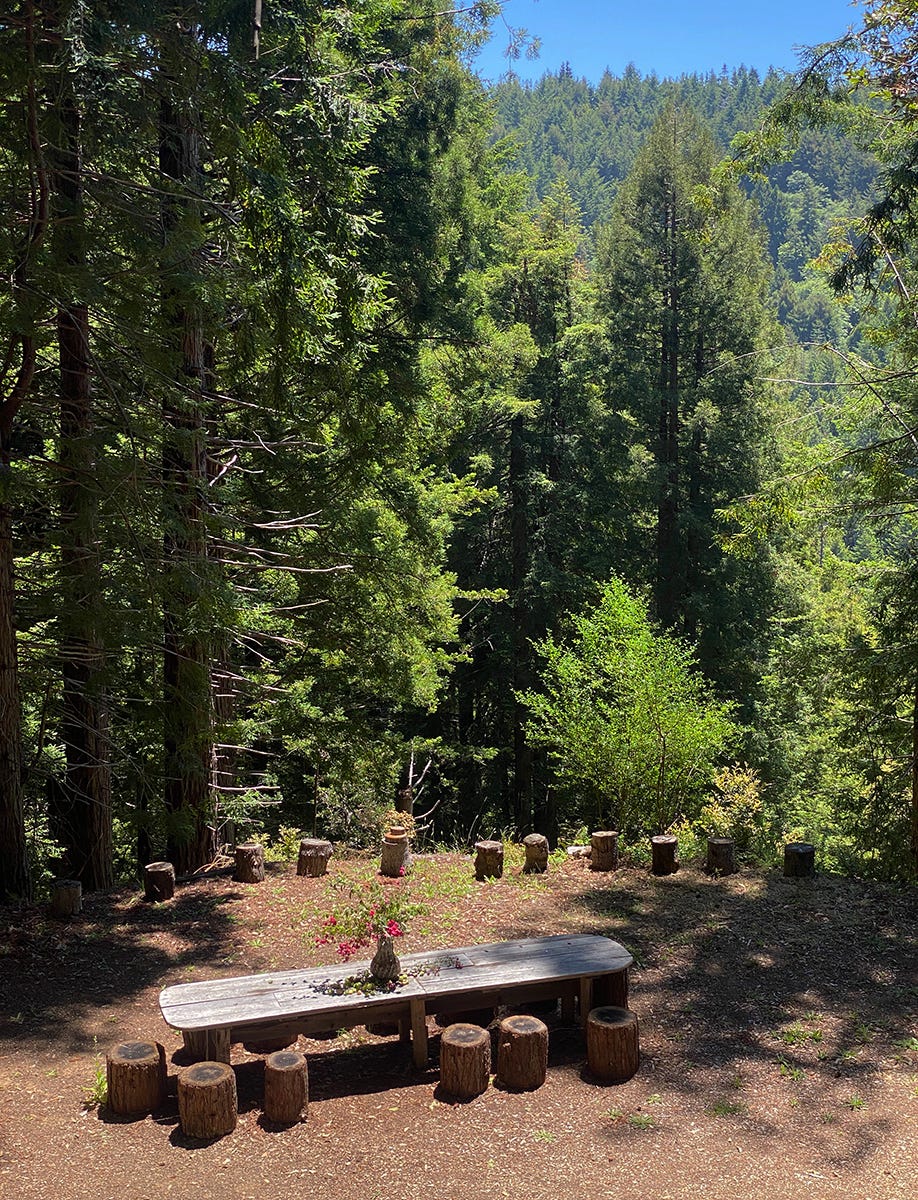
Last summer I visited Salmon Creek Farm for the summer solstice. The days alternated between unseasonable cold in the dark shade of the redwoods and glorious warm sun in the gardens. Carving out an opening in the forest to plant a garden – the first step for a commune. SCF is iconic for its cabins in the woods, but its golden heart is the garden – a source of sustenance and a place for gathering, its labor and bounty marking the seasons. Garden-making is world-making. I found Derek Jarman’s Modern Nature on a shelf at Rainbow and took it as a sign that I should finally read it after meaning to for a long time.
“Certain gardens are described as retreats when they are really attacks.”
A quote from Ian Hamilton Finlay, read by Fritz Haeg at the SCF dinner in October in Los Angeles.
Last fall I started on a garden reading list: in addition to Modern Nature, there was Olivia Laing’s Garden Against Time and William Morris’ News from Nowhere. I was looking for political gardens, utopian gardens, gardens that spoke of the land they were created on and a vision of what a garden could be in these times.
Lately I’ve been wanting to re-read the books I read in my youth – what would I think of them now? So I picked out John Berger’s Keeping A Rendezvous from my bookshelf and the first essay was about making art in the time of oppression. The second essay was dedicated “For Tamara and Tilda and Derek J.” Derek Jarman?
Books talking to books.
This spring I finally made a long-anticipated pilgrimage to the gardens that I had only read about.
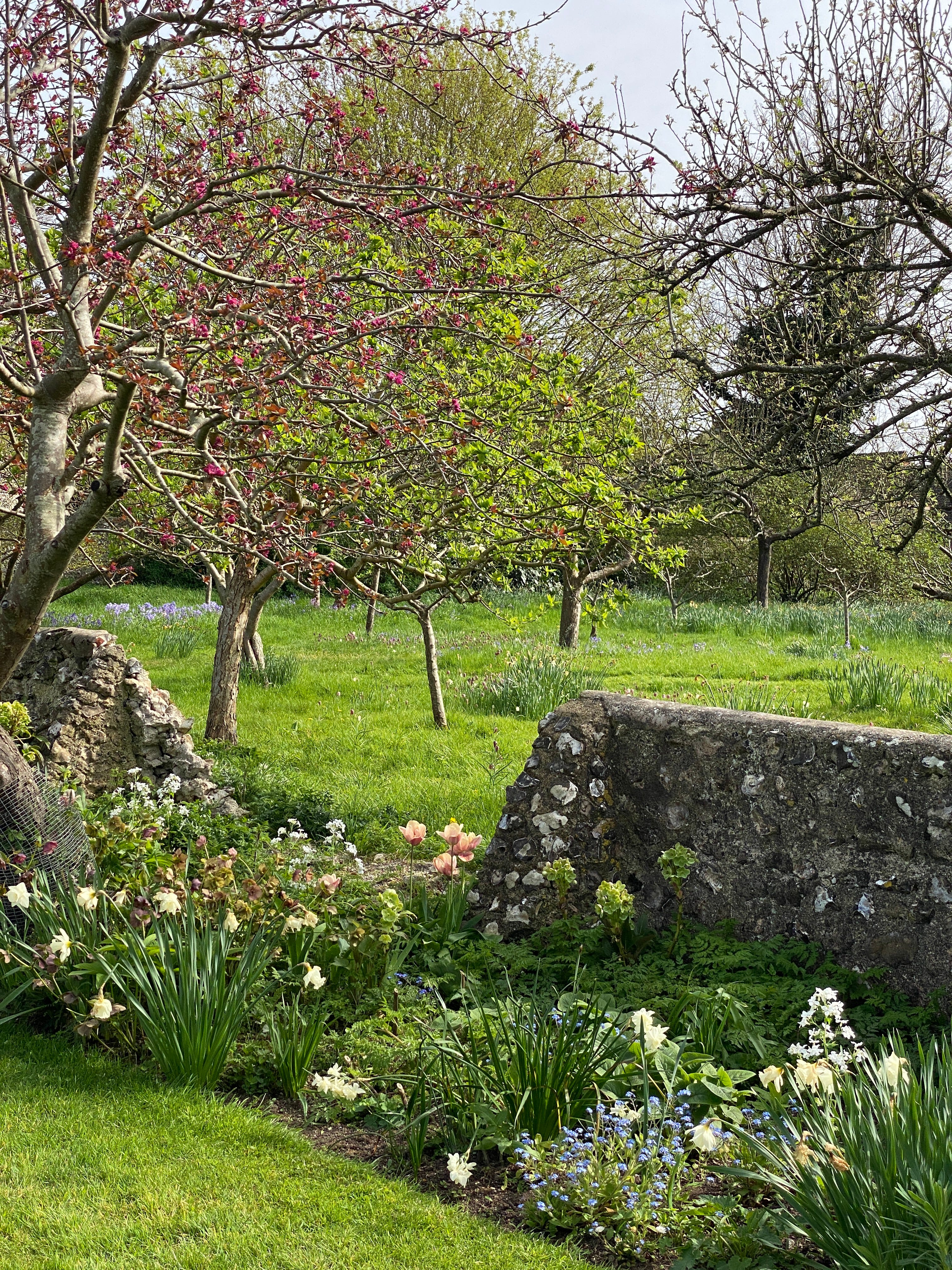
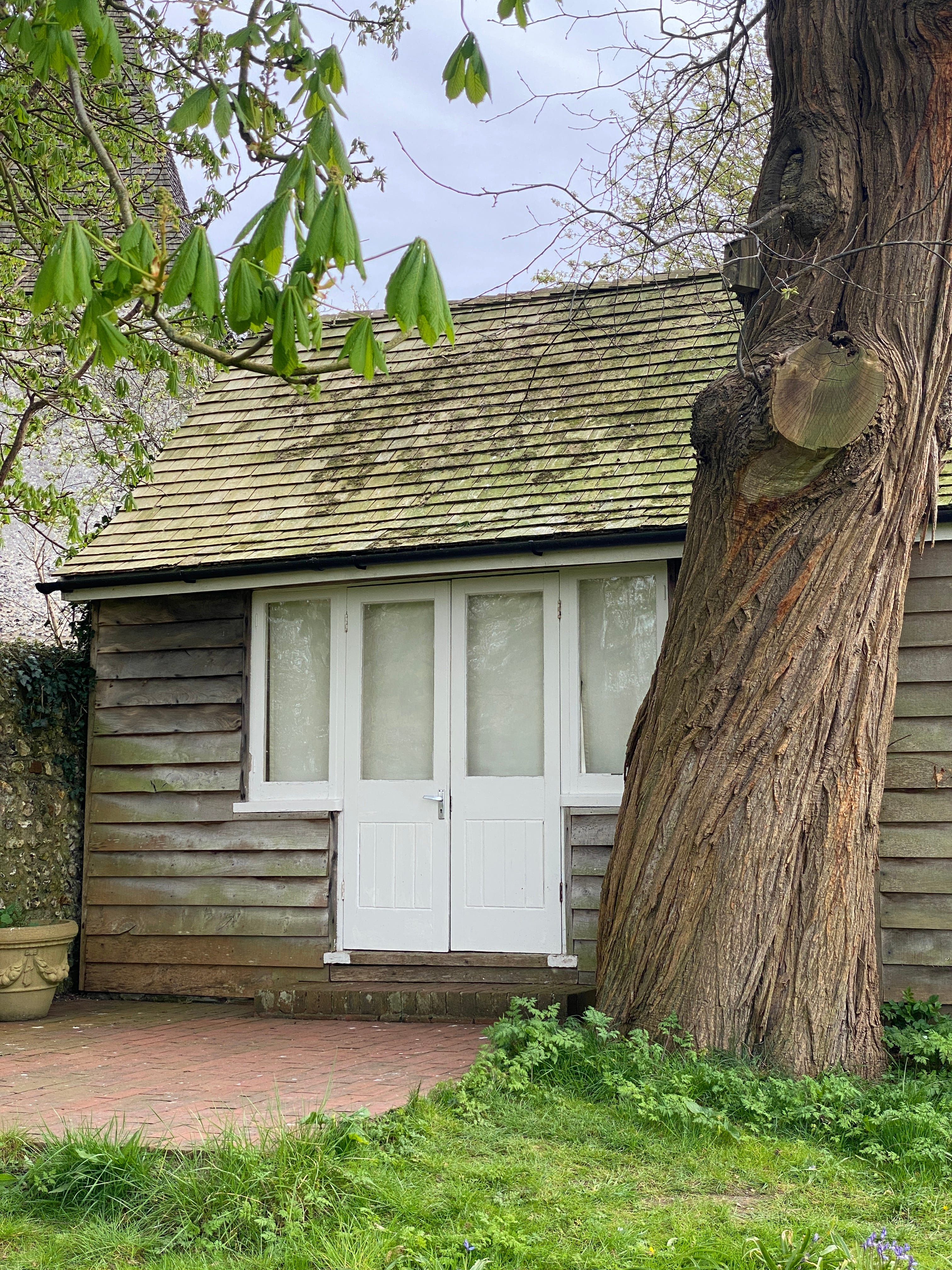
I started at Monk’s House, the home of Virginia Woolf. I discovered the bones of a structure that would repeat itself through the other gardens: a formal, walled garden of showy colors by the house; an orchard of fruit trees set in grasses and, in April, scattered with fritillaria and narcissus, with simple mown paths indicating where to step; a working vegetable garden in neat rows hidden behind a hedge. At the far end of the orchard, the writing studio – a room of her own! – with an enormous tree growing out of the side – I learn that Virginia and her sister Vanessa and brother Toby were the inspiration for Howards End – was this studio with the tree growing out of its side the inspiration for the house and tree in Howards End? The dates don’t align but what a premonition.
Gardens talking to books.
“Miranda slept in the orchard—or perhaps she was not asleep, for her lips moved very slightly as if they were saying: ‘Ce pays est vraiment un des coins du monde . . . oui le rire des filles . . . eclate . . . eclate . . . eclate.’ and then she smiled and let her body sink all its weight on to the enormous earth which rises, she thought, to carry me on its back as if I were a leaf, or a queen…”
From Virginia Woolf’s In The Orchard, written in her orchard. A garden for the senses, for the body.
“I was quite unable to deal with the pain of discovering that people hurt each other; that a man I had seen had killed himself. The sense of horror left me powerless. But in the flower I found a reason; and was thus able to deal with the sensation.”
From Virginia Woolf’s memoir A Sketch of The Past. Always the project of reconciling living in this world.
The River Ouse at the bottom of the hill; a shadow, a reminder.
On to Charleston House, a seven-mile walk on country lanes from Monk’s House, where Virginia would visit her sister Vanessa Bell and Duncan Grant, along with a shifting domestic scene of friends and lovers. Every possible surface is a riot of pattern and figures, painted by Vanessa and Duncan and everyone who stayed in the house. Every lamp is hand-made, every tile hand-decorated, every curtain hand-sewn. A pheasant - I’ve never seen one before! - it is absurdly decorative - sought refuge in the walled garden. Bell and the others moved there during the war because they were conscientious objectors; the men had to work as farm laborers if they wouldn’t be soldiers. The docent tells me that they were chased by the farm boys and so tired at night that they could only paint small objects—such as the firewood crate!


Prospect Cottage is a jump forward in time, and out of the walled garden. Everything here is shingle. The bright yellow window frames are an echo of Salmon Creek Farm, although they predate Derek Jarman himself. I’ve seen the iconic photos of the garden, but am completely surprised by the poem covering the south side of the house. Letters cut from wood, in Jarman’s hand-writing, The Sun Rising by John Donne. Instantly feels like a stage set, fittingly. The wall is in full sun, and the warmest spot in the windy morning, but I can only pick out a few phrases from his handwriting - “happy as wee” - so I have to look up the poem later.
The ending of it:
Thou, sun, art half as happy as we,
In that the world’s contracted thus.
Thine age asks ease, and since thy duties be
To warm the world, that’s done in warming us.
Shine here to us, and thou art everywhere;
This bed thy center is, these walls, thy sphere.
Imagine that! To command the sun!
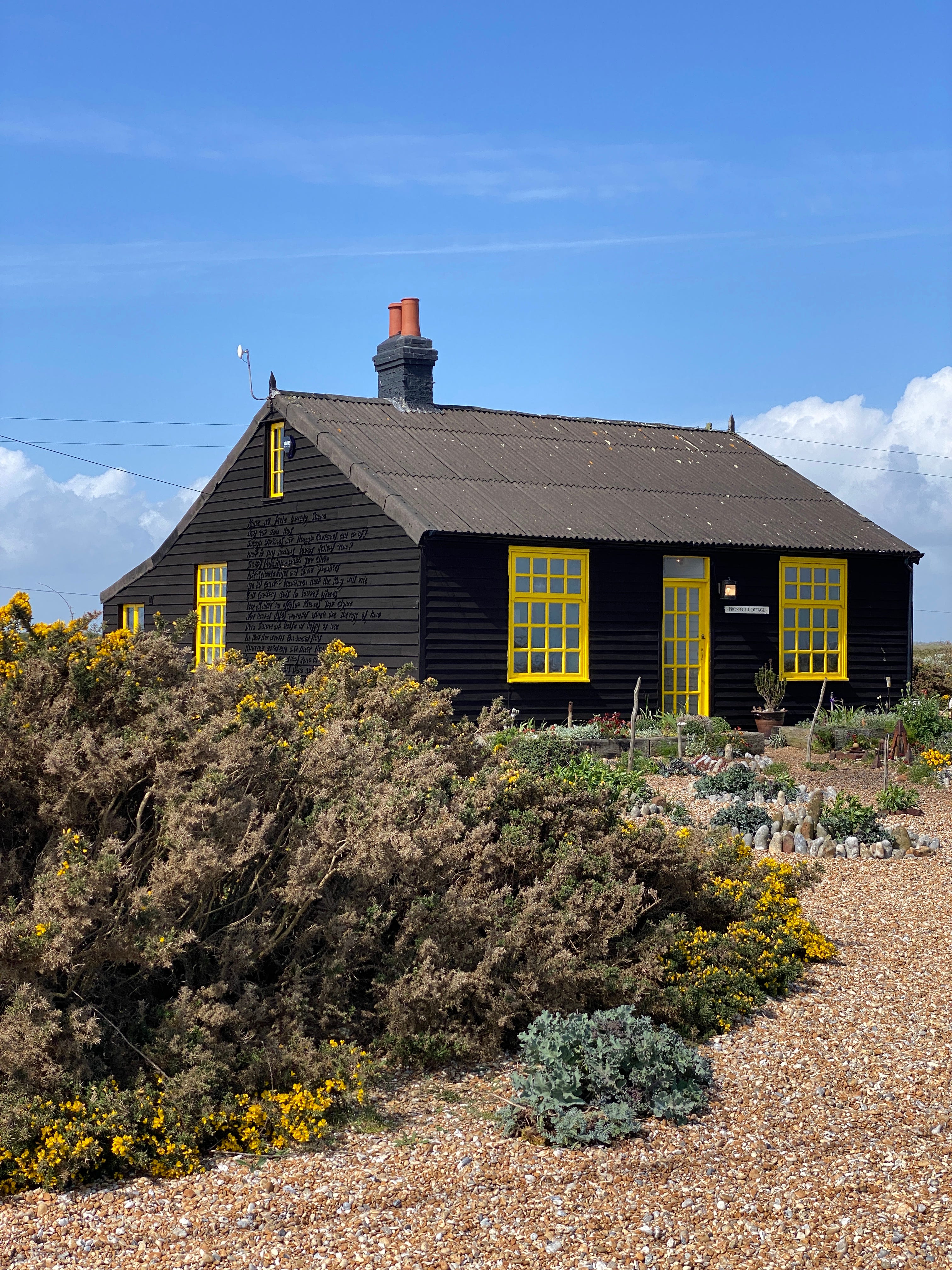
The sea is receding here – a head-turning notion in a world of rising sea levels. Empty fishermen’s huts and winches that were once used to pull up boats have been left abandoned over time as they get farther from the sea – visible ghosts.
I get there before the tour starts and wander around the garden by myself. Heavy rusted chain spirals, rebar curlicues like scribbles, gathered shells, driftwood, stones. Totems. The traditional flower bed becomes a ritual circle. The garden like an incantation.
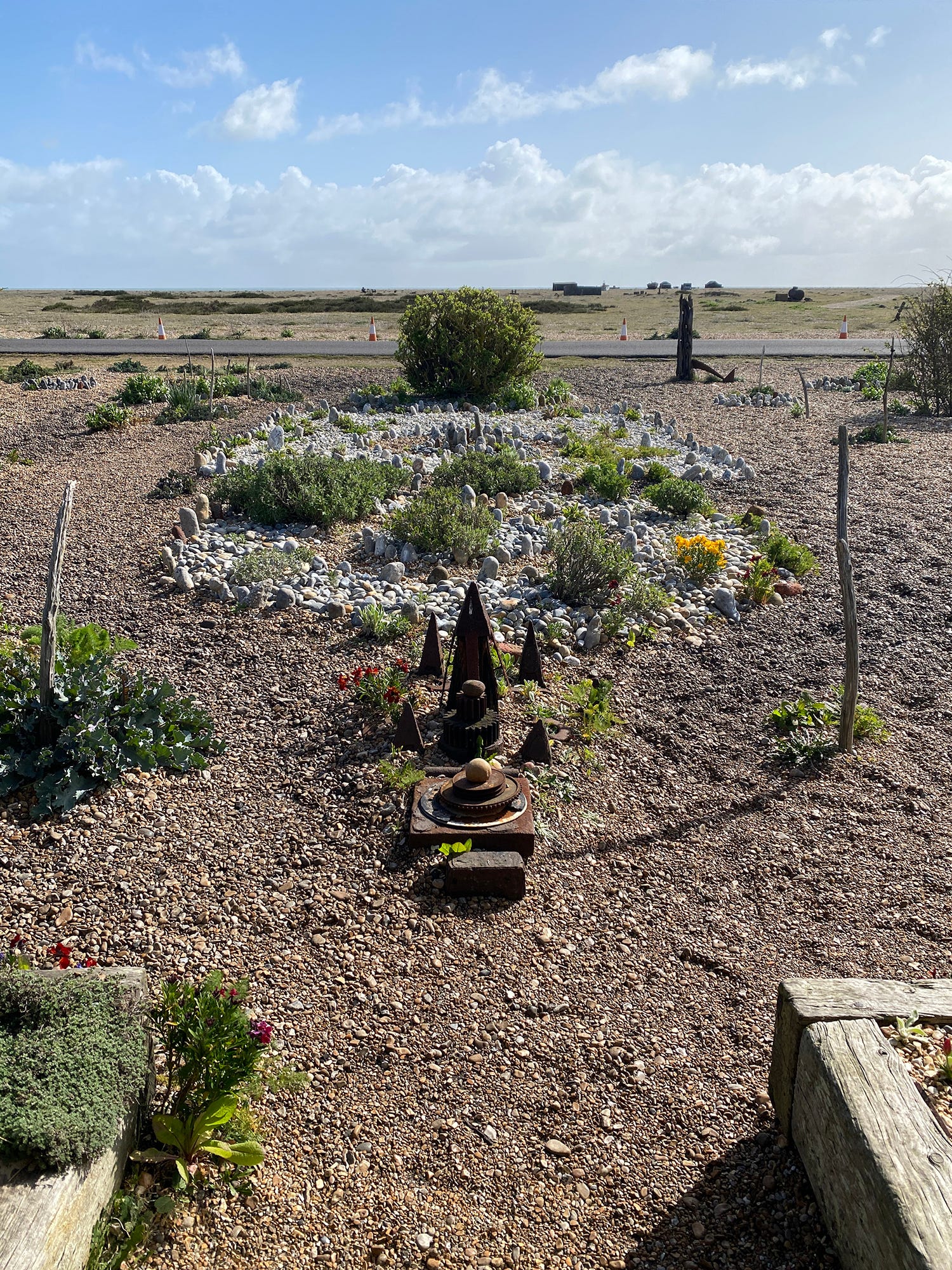
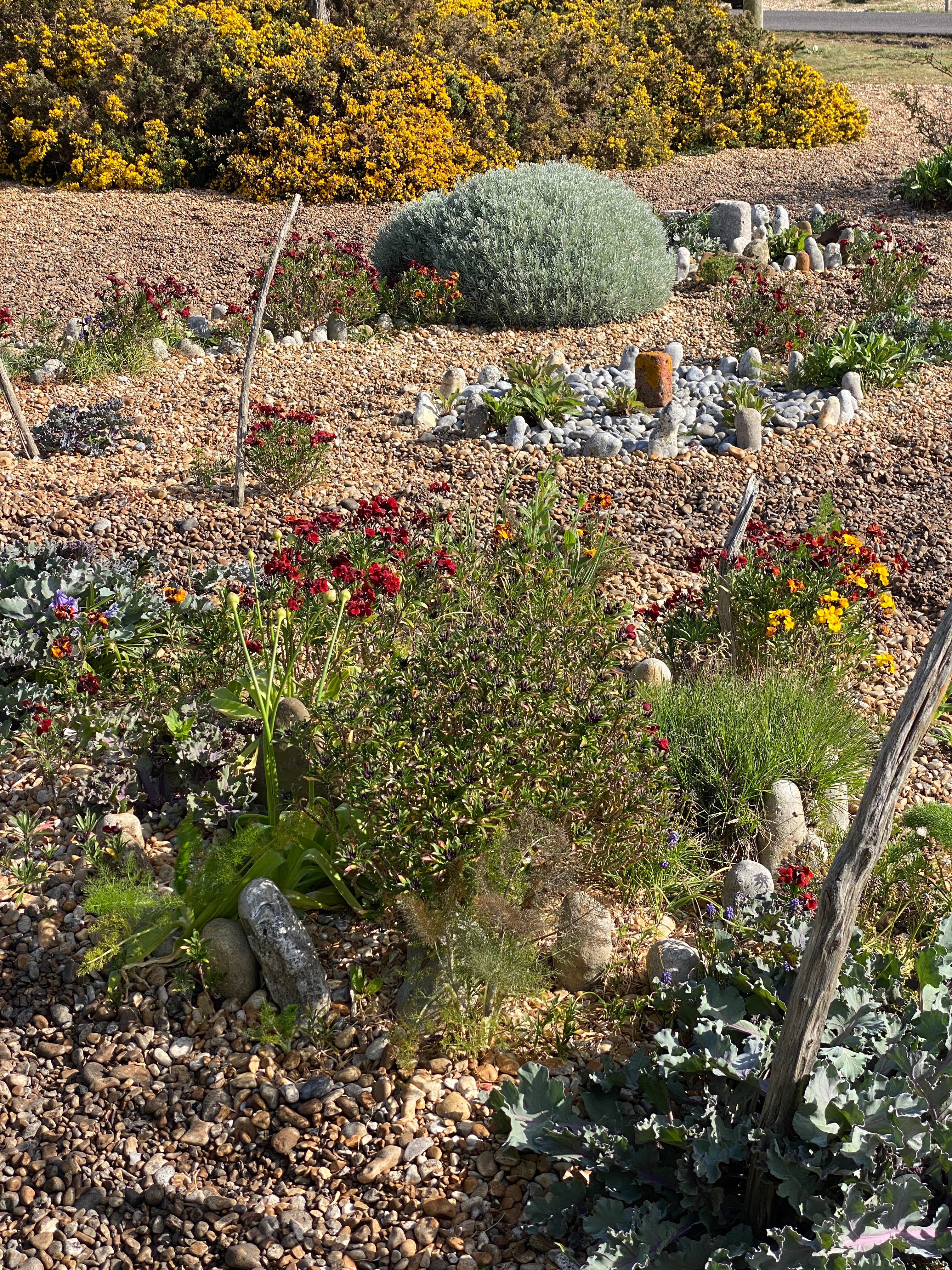
So many stones. The shingle is mostly tan stones but in the garden there is a bed of only grey stones that have been carefully picked out – that simple act of creation. Stones are placed upright like dragons’ teeth becoming soldiers, like standing stones. In Modern Nature Jarman imagines the stones in a distant future under the sea again, speaking of their time on earth. Every flower is a flower of myth, of folklore: Rose, Poppy, Narcissus. The lushness of his writing, describing the garden, the sky, the sea. The garden as a place of secret pleasures. Again, the garden, the body.
His entry for Saturday, April 15:
“My garden is a memorial, each circular bed and dial a true lovers knot—planted with lavender, helichrysum and santolina.
Santolina, under the dominion of Mercury resisteth poison, putrefaction, and heals the bites of venomous beasts. Whilst a sprig of lavender held in the hand or placed under the pillow enables you to see ghosts, travel to the land of the dead.”
Jarman wonders if he will see the rosemary that he plants in bloom. Every garden is planted for an unknown future, in hope.
Sissinghurst is a proper English garden. Walled garden rooms, axial views, orthogonal hedged paths. Writer, gardener, lover of Virginia Woolf, inspiration for Orlando, Vita Sackville-West knew she wanted the property when she saw the tower – she co-opted it for a writing room and no one was allowed in it except for her dogs. (The tea: Jarman visited Sissinghurst, and did not have the most complimentary things to say about the famed White Garden.)
I follow one never-ending axial path straight from the entrance gate through garden room after tower after orchard, arriving at the focal point of a sculptural figure in the stone-edged moat – but then I turn around and am completely on tilt – the sculpture is somehow also the focal point of a completely different path, just a few degrees angled away. What I thought was an orthogonal order was in reality a tricky series of skewed axes and centers, stretching space.
The walls and hedges create each miniature world. Outside, there are sheep in the meadows and bluebells in the woods. Satisfies all my English garden fantasies.


Great Dixter, created by Christopher Lloyd in the 1950s, is a Seussian fever dream of a garden. Red and orange rising out of a periwinkle and chartreuse cloud. Scarlet on purple on yellow. There are no axial views here – every view line kinks. Paths are pushed to the perimeter of garden beds, against a bulgy yew hedge that forces you to trace its curves with your body. I circle endlessly trying to make sense of it all, until by the end of the afternoon I’ve succumbed.
Lloyd actually saw Prospect Cottage by accident in 1990 – traveling with Beth Chatto, his eyes were drawn by California poppies (!):
“We walked towards the car and then I spotted some brilliant flower colour; I headed for it. Houses, well separated, are strung out along this road on its inland side. There are no visible boundaries or fences. I made a beeline for that colour. It hadn’t just happened, like the wild flowers that make such vivid displays beneath the dazzling openness of the sky, yet nowhere else were any of the habitations making the slightest attempt to garden. Here, around a timber cottage tarred black but with cheerful yellow window frames, a garden had been made.”
Lloyd and Jarman kept up a friendship - plants from Great Dixter were gifted to Jarman and planted in the shingle, Jarman sent stones in return that went into the great floor mosaic at Great Dixter.
Gardens talking to gardens.
Last November I started my own garden, in a community garden plot, after ten years on the waiting list. Beginning a garden is also beginning a new relationship to time. I’m testing things out - throwing seed (yes, the SCF seed mix!), waiting to see what comes up, learning patience. I leave the gate open when I’m there so people can wander in. My garden gets shaggy. I leave the flowers to turn into seed, some things die, others get eaten. The garden is living in cyclical time, looking back, looking forward. All becomes mulch, returns to the soil, the only way I can learn to let go, the promise of eternal return.
- Krystal Chang
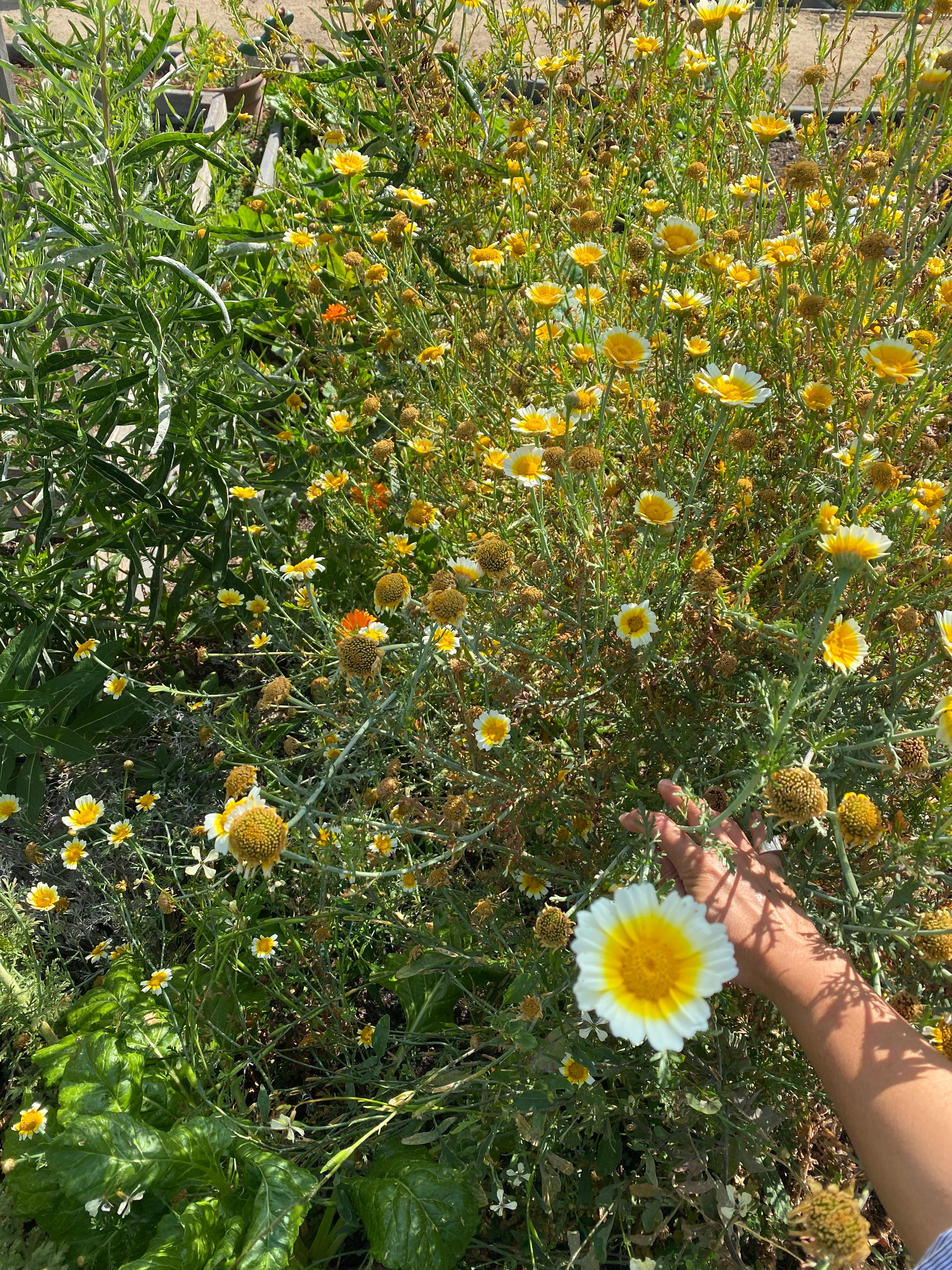
If you know Salmon Creek Farm, you know that we love a wild garden - what we don’t harvest or eat, we let flower, dry up, set seed, and naturalize, allowing it to become progressively wild through the season - inspired in part by Masanobu Fukuoka’s 1975 book “The One-Straw Revolution.” Every year, around late summer to early fall, when the garden begins to dry out, we hand-harvest the seeds that become our SCF seed mix, a blend of 28 varieties of greens, grains, flowers, edible cultivars, and wildflowers - including a cute bandana with sowing instructions designed by SCF friends Lexi Visco and Calvin Rocchio of Companion Platform.